
The Sustainable Finance Disclosure Regulation has had a complicated life. Designed as a transparency tool, it became something else entirely: a pair of marketing labels, Article 8 and Article 9, that the market adopted as proxies for sustainability quality, with predictable consequences. Comparability suffered. Greenwashing concerns grew. Investors struggled to understand what they were actually buying.
SFDR 2.0 is the attempt to rebuild the framework on clearer foundations. And in late April 2026, the European Parliament's Committee on Economic and Monetary Affairs (ECON) published its draft report, setting out Parliament's initial position on what that rebuild should look like.
The short version: Parliament wants a tighter, more ambitious framework than the Commission originally proposed. And for asset and wealth managers, the practical implications are significant.
From disclosure to labelling
The draft supports the Commission’s shift toward a simplified categorisation system: Sustainable, Transition, and ESG Basics. The intent is to move from a world of complex, often incomprehensible disclosures to one of clear, investor-readable labels, where the label actually corresponds to the investment approach it describes.
The rapporteur, Gerben-Jan Gerbrandy, has described his objective as making legislation that “people can understand and use” and that “protects consumers” while relieving firms of unnecessary bureaucratic burden. In practice, the draft does the first two clearly. The third is more complicated, particularly for firms that have relied on the existing Article 8 and 9 categories across a wide product range.
What Parliament is proposing
The ECON draft broadly adopts the Commission's architecture but adds material proposals across several dimensions.
Mandatory PAI disclosure for all categories
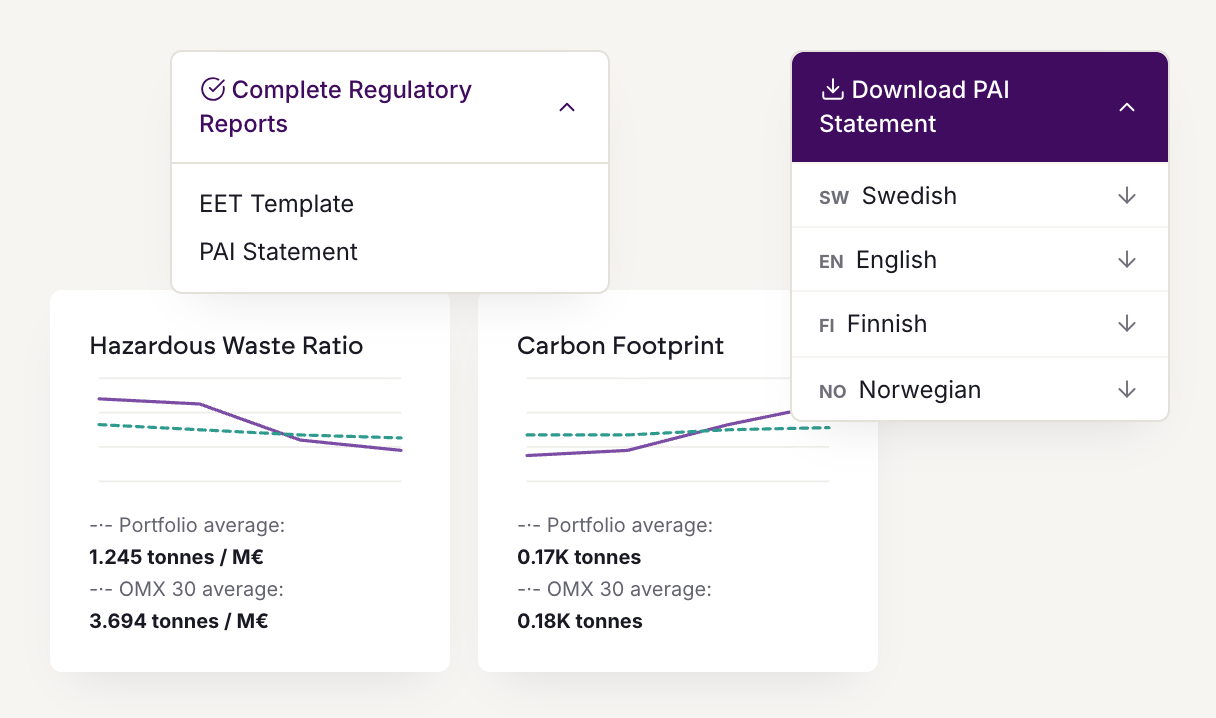
Under the proposals, products in the “ESG Basics” category would also be required to disclose principal adverse impacts - mandatory PAIs would apply to all product categories, not just Transition and Sustainable funds. This is a meaningful departure from the Commission’s position, and from current practice where many Article 8 funds disclose PAIs voluntarily or not at all.
For firms managing broad product ranges, this changes the calculus significantly. You can no longer limit robust PAI data collection to your highest-conviction ESG funds. Systematic, portfolio-wide data coverage becomes the baseline requirement.
Higher minimum thresholds
The rapporteur proposes raising the minimum share of taxonomy-aligned investments from 15% to 20% for Transition and Sustainable categories, and wants to remove the automatic safe harbour that allows funds using official EU climate transition benchmarks to qualify for a category.
A minimum 70% investment threshold would apply across all categorised products. In other words, at least 70% of portfolio holdings must be aligned with the sustainability-related claim associated with the fund's category.
The remaining 30% may be allocated more flexibly. However, the draft report specifies that these investments must not contradict the sustainability-related claims of the product.
Additionally, for ESG Basics products, the draft report highlights that the average ESG rating must outperform that of their universe or benchmark, after eliminating the bottom 20% of lowest-rated securities (Amdts 25 & 26).
Disclaimers for non-categorised products
Any product that references sustainability factors but doesn't use one of the new category labels will need a clear disclaimer. That disclaimer must confirm the product does not meet EU standards for defining sustainable financial products and protecting against greenwashing.
For managers with funds that use ESG-adjacent language in their names or marketing without meeting the new category requirements, this is an operational and reputational consideration as much as a compliance one. In addition, an unlabelled fund may simply fall outside institutional clients’ investment policies. For asset managers, that creates a risk of losing the mandate, and therefore a potential commercial risk.
Packaged investment products included
Parliament proposes that packaged investment products - including structured securities - be included in the definition of financial market participants, bringing them within scope of SFDR 2.0. This extends the reach of the framework beyond traditional fund structures.
No carve-out for professional investor funds
The proposals do not include a carve-out for funds marketed only to professional investors - something that had appeared in the Commission's leaked draft proposals but was subsequently dropped. Asset managers serving institutional-only client bases should not expect exemption.
It is important to note that these proposals remain subject to negotiation and may change during the Parliament-Council legislative process.
The transition timeline
A transitional period of 24 months is generally proposed for the new requirements. However, relief measures already included in SFDR 2.0 - such as the removal of entity-level PAIs - are intended to enter into force immediately. This creates an asymmetric implementation picture: new obligations phase in over two years, but some of the current burden reduces straight away.
The ECON Committee is scheduled to vote on these proposals in mid-July 2026. After that, the report goes to a European Parliament plenary session before political negotiations between Parliament and the Council begin. The final shape of SFDR 2.0 remains subject to political agreement, but the policy direction is increasingly clear.
What this means for your data infrastructure
The thread running through all of these proposals is the same: sustainability claims need to be substantiated by real, structured, auditable data. Not estimates. Not voluntary disclosures. Not scores borrowed from a single vendor without understanding what's underneath them.
Mandatory PAI reporting across all categorised products means asset managers need reliable coverage of the indicators that matter - carbon intensity, biodiversity exposure, social violations, governance flags - across their full investment universe, not just their Article 9 funds.
The disclaimer requirement for non-categorised products means that every fund referencing sustainability in its name, documentation, or marketing needs to be reviewed against the new category thresholds. That review requires data.
And the raised taxonomy thresholds for Transition and Sustainable categories mean that the measurement of taxonomy alignment needs to be both broader and more rigorous than many firms currently manage.
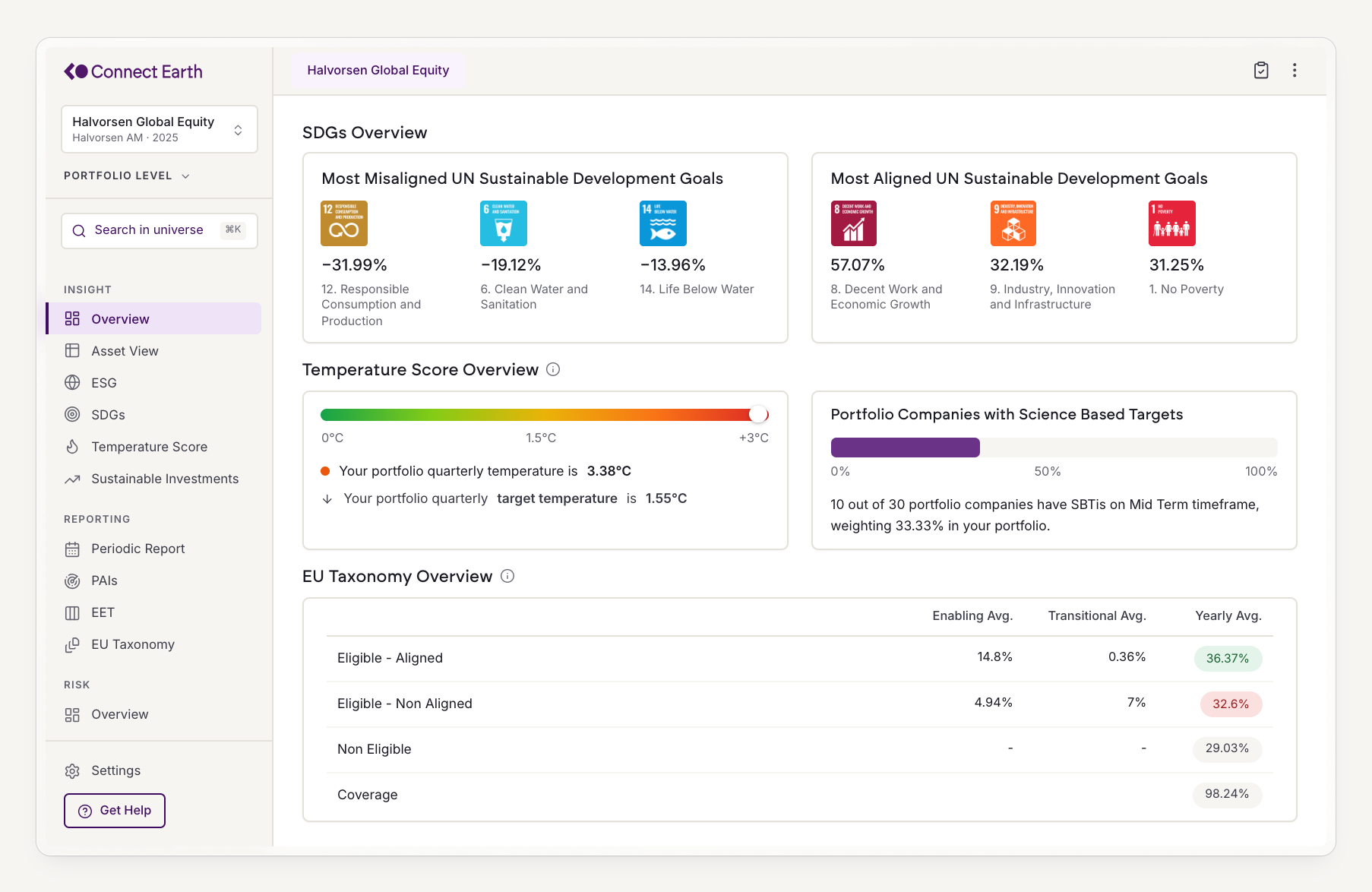
At Connect Earth, this is the work we do with financial institutions like asset managers, fund managers, and insurers every day. We help clients map their current ESG and PAI data coverage, identify gaps relative to regulatory requirements, and build the infrastructure to report with confidence. Whether that's SFDR fund-level reporting, PAI indicators across a broad portfolio, or tracking taxonomy alignment across mixed asset classes, we can help you understand where you stand.
Firms that begin preparing now - by reviewing their fund categorisations, their PAI data gaps, and their vendor coverage - will be far better placed than those waiting for the final text to land. The direction is clear. The data requirements are substantive. The time to act is now.
Get in touch
If you want to understand what SFDR 2.0 means for your specific fund range and data set-up, we're happy to walk through it with you. Reach out to the Connect Earth team at connect.earth.