Carbon measurement & insights
What are carbon emissions (CO2 emissions)?
CO2 is recognised as the primary greenhouse gas emitted through human activities. CO2 emissions stem from the burning of fossil fuels and the manufacture of cement. In our day-to-day lives, they're mainly linked to the energy we consume, the things we buy and the vehicles we drive.
What are GHG, CO2 and CO2e?
Greenhouse gases (GHGs) are gaseous compounds that absorb infrared radiation, trap heat in the atmosphere, and contribute to the greenhouse effect. GHGs include carbon dioxide (CO2), methane (CH4), nitrous oxide (N2O), and fluorinated gases among others. CO2 (carbon dioxide) is a colourless, odourless greenhouse gas released when fossil fuels burn. Carbon dioxide equivalent (CO2e) is a way of combining all the GHGs into a single metric, by using their global warming potential values. This allows a much easier comparison of different sources of emissions.
What are scope 1, 2 and 3 emissions?
The Greenhouse Gas Protocol Corporate Standard classifies a company's greenhouse gas emissions into three scopes which reflect an organisation's total greenhouse gas emissions:
- Scope 1 emissions: Direct company emissions from sources that are controlled or owned by the organisation (buildings, on-site energy consumption, company vehicles etc.).
- Scope 2 emissions: Indirect company emissions associated with the purchase of electricity, steam, heat or cooling.
- Scope 3 emissions: Indirect company emissions (not included in scope 2) that occur in the value chain of the reporting company (transport and distribution, business travel, investments, use of sold products etc.). Scope 3 emissions are the biggest contributor to total company emissions for a number of industries, yet simultaneously, they are the hardest to track and calculate.
How do you calculate the CO2e emissions for a transaction?
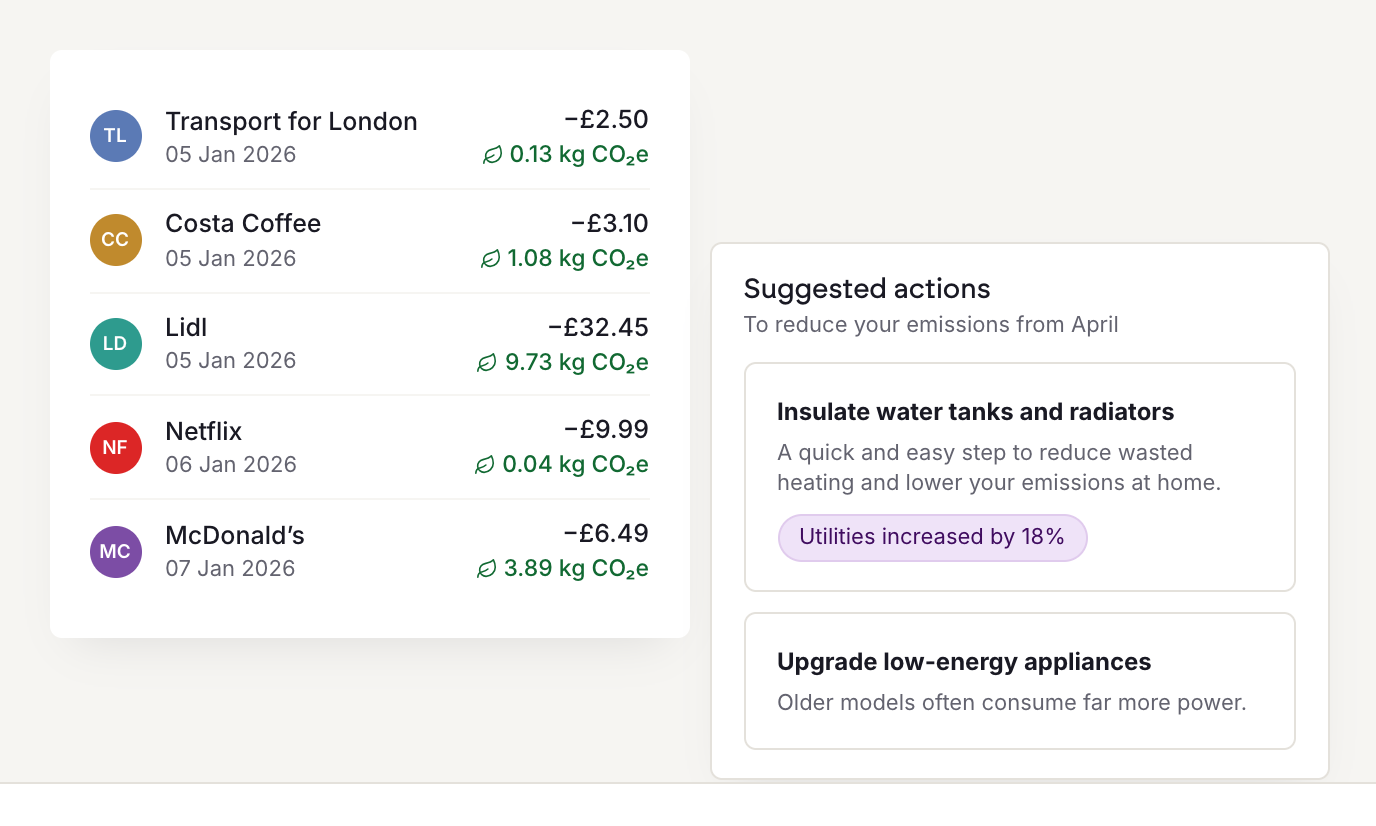
We calculate the carbon footprint of your purchases using 'emissions factors' that are specific to the category and region of your purchase.
The calculation is: Transaction Amount × Category Emissions Factor
For example: If you spend £20 at a supermarket, we multiply this by the emissions factor of groceries in your specific country (e.g. 2.22 kg CO2e/£) to get an estimated carbon footprint of 9 kg of CO2e.
How accurate are your CO2e emissions estimates?
The estimates shown provide a general and approximate indication of the environmental impact associated with your spending. While we strive for accuracy by using industry-standard emission factors and reliable data sources, these estimates are based on broad assumptions and may not account for variations in specific product choices or supply chains. The accuracy depends on the quality of the underlying data and the comprehensiveness of industry averages.
Where do you get the data from?
Category-level data: We collect category-level data through Environmentally-Extended Input-Output Analysis (EEIO) using the latest version of the EXIOBASE database. EXIOBASE is one of the most extensive EEIO models available and enables us to track greenhouse gas emissions throughout global supply chains.
Corporate emissions data: We collect the latest reports that companies have published, containing emissions data. These may be sustainability reports, ESG reports, CSR reports, and others.
What is your data's geographical coverage?
Category-level data: We are currently covering 49 countries (32 in Europe, 5 in the Americas, 8 in Asia & Pacific, 2 in Africa and 2 in the Middle East). Country coverage of the EXIOBASE database accounts for about 90% of the global gross domestic product.
Corporate emissions data: Our corporate emissions data covers companies headquartered in nearly 100 countries. The most common countries are the USA and the UK which make up 28% and 12% of our dataset, respectively.
How does the integration work?
The integration is only API-based. The API integration is easy and accompanied by a well-detailed API documentation that makes the process straightforward. Integration typically takes anywhere between 2-6 weeks, depending on the technology and resource capacity of our customers.
How secure is the API? Do you store any user data?
We do not store any user data nor do we require access to user data (such as personal information, account details, etc.). We fully comply with banks' and financial institutions' legal and compliance requirements in terms of data security. As a UK-based company following data compliance standards like GDPR and SOC2, we take data privacy and ownership very seriously and are audited yearly for data privacy and security.
Why should businesses care about greenhouse gas emissions?
Businesses see a positive return on investment from developing corporate value chain and product GHG inventories. The GHG standards help companies to:
- Identify and understand risks and opportunities associated with value chain emissions
- Identify GHG reduction opportunities, set reduction targets and track performance
- Engage suppliers and other value chain partners in GHG management and sustainability
- Enhance stakeholder information and corporate reputation through public reporting
By following the GHG Protocol, businesses can not only reduce their emissions but also cut costs and meet strategic business objectives.
Compliance & reporting
For what kind of assets does Connect Earth offer data?
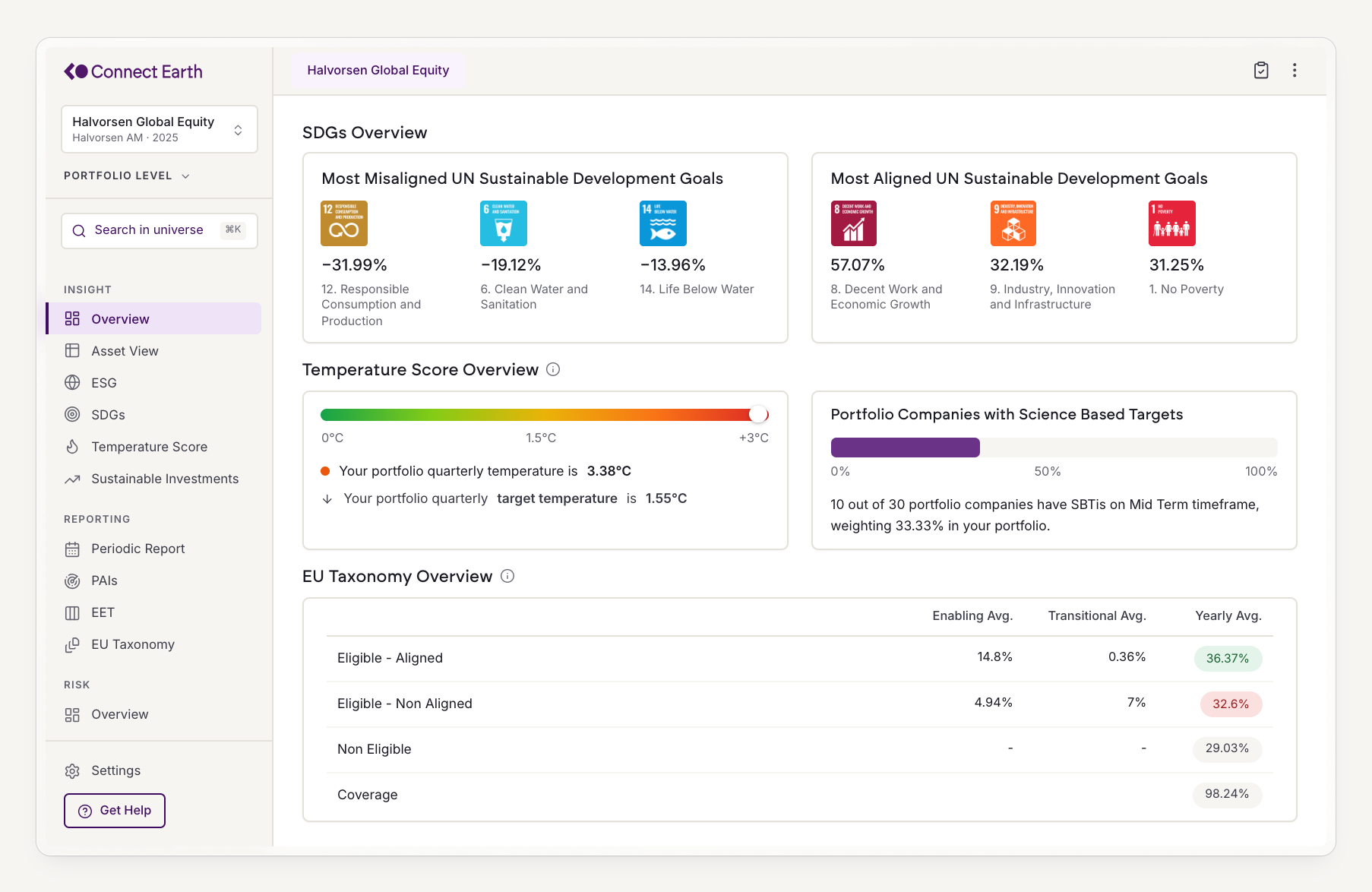
Connect Earth aggregates sustainability information of +36,000 publicly traded companies, +210,000 publicly traded funds, and sovereign bonds of +210 nations. Additionally, Connect Earth has the infrastructure to map any ISIN to the underlying issuers, ensuring best-in-class coverage regardless of the instrument you're investing through.
What will my data coverage be using Connect Earth's universe?
It depends on the companies, funds, and bonds within your portfolio. Our team offers a data coverage check as part of the product demo. If you want to make a coverage check, reach out at www.connect.earth/demo. If your fund invests in non-public companies, Connect Earth can help you fill in the gaps with a Data Request solution. You can request sustainability data input directly from your investees.
How is Connect Earth's data sourced?
Connect Earth combines its own research with multiple third-party data providers. This creates a complete data lake with multiple versions of the same data point. We have an internal quality assurance process to verify the data. Our team, then, selects the indicators with more documented and detailed data sources to select the best available source for any given KPI.
How much does Connect Earth cost?
Subscription values change according to the solutions you are interested in (ESG, SDGs, SFDR, EET, EU Taxonomy, and Stewardship), as well as the number of funds and volume of assets your entity manages. Fill in the form at www.connect.earth/demo to request a quote from our team.
Can I use my own sustainability data or data from other providers?
Yes, you can upload your own sustainability data or data from multiple data providers to Connect Earth and take full advantage of the automated calculations of sustainability KPIs on fund and entity levels. Our technical team is ready to assist you during the process. The onboarding of your own data to our platform takes about 3 to 7 days, on average.
What is the benefit of using Connect Earth combined with your current data provider?
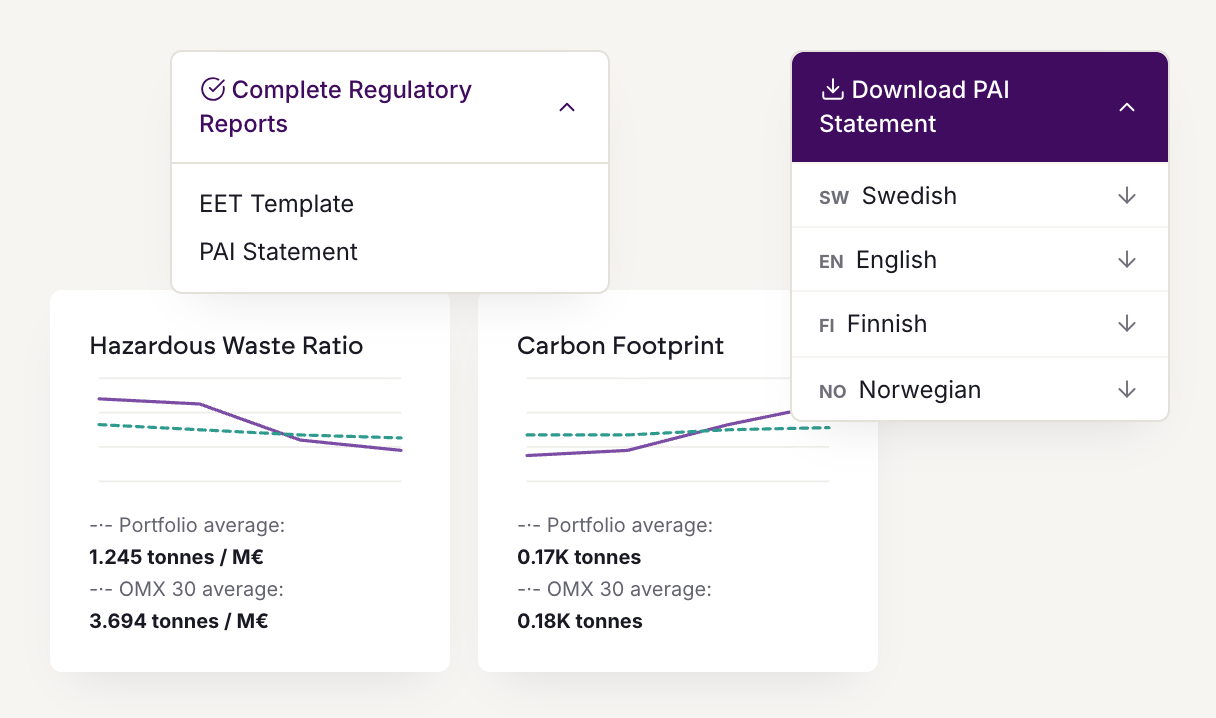
You can use your own sustainability raw data or data from multiple providers and still take full advantage of Connect Earth's automation to calculate your fund and entity-level KPIs. Additionally, you can export final reports in compliance with the latest regulation and templates (SFDR's PAI statement and European ESG Template). Here's how Connect Earth can improve your current sustainability workflow:
- If you use your own data, you can still have access to Connect Earth's metrics as a fallback to increase your data coverage;
- Our technical team can work closely with you to continuously improve the quality of your sustainability data;
- You can use our technology to make real-time searches for +48,000 companies and +213,000 funds in less than a second per search;
- Reports are generated 20 to 30 times faster than at other sustainability data providers.
Get started with the Sustainable Finance OS today
Whether you use one module or the whole system, embedding sustainability into your business helps build a future your customers, and your bottom line, will thank you for.