
The ESG ratings market has operated without formal regulatory oversight for years. That is about to change. On 1 December 2025, the Financial Conduct Authority (FCA) published its consultation paper CP25/34, setting out its proposed approach to regulating ESG ratings providers for the first time. The consultation closes today, March 31st 2026.
For financial institutions that rely on ESG ratings to inform investment decisions, portfolio screening, and regulatory reporting, this is a significant development. The quality and comparability of the data underpinning those ratings has long been a source of concern. The FCA's own research found that 55% of ESG ratings users are worried about how ratings are constructed, and 48% about how transparent the methodologies are. Regulation is the industry's answer to both problems.
Why Regulate ESG Ratings Now?
The push for regulation has been building for some time. In 2023, HM Treasury consulted on bringing ESG ratings within the FCA's remit, with strong industry support for greater oversight. In October 2025, the Government published the enabling legislation, formally establishing ESG ratings as a new regulated activity. CP25/34 is the FCA's first concrete step towards turning that legislative framework into working rules.
The core problem the regulation is trying to solve is well understood by anyone who uses ESG data professionally: different providers assess the same company and arrive at materially different scores, with little clarity about why. For financial institutions building SFDR-compliant products, meeting PAI reporting obligations, or conducting counterparty ESG due diligence, that inconsistency creates genuine operational and reputational risk.
What is an ESG Rating?
For the purposes of the new regime, an ESG rating is an opinion, score, or assessment of a company's, product's, or fund's performance across environmental, social, and governance factors, where that rating is likely to influence a decision to make a specified investment. "Providing" a rating covers both producing it and making it available, including publishing it online or issuing it to a third party.
What the FCA Is Proposing
The proposed rules are built around four interconnected areas.
Transparency sits at the core. ESG ratings providers will be required to meet minimum disclosure standards for both product lines and individual ratings. Crucially, these disclosures must be easily accessible, prominent, and free to obtain for the relevant stakeholders — including the investors and institutions using them. Some disclosures will need to be made public; others can be directed to users and rated entities, with the option to publish them more broadly.
Governance requirements will be extended to ESG ratings providers in line with the standards already applied to other FCA-regulated firms. This includes expectations around oversight structures, accountability, and the presence of individuals with genuine operational responsibility for the ratings process in the UK.
Systems and controls proposals draw on the FCA's existing Financial Crime Guide to help firms identify, monitor, and manage risks including market manipulation and the misuse of non-public information in the ratings process.
Conflicts of interest management will be a formal obligation. Given that some providers offer both ratings and advisory services to the same entities they assess, robust conflict identification and mitigation is central to the FCA's proposed framework.
The proposals are aligned with international standards, including IOSCO recommendations and the industry-led ICMA Code of Conduct for ESG Ratings and Data Providers.
Who Is In Scope?
Any firm providing ESG ratings likely to influence investment decisions in the UK will require FCA authorisation. Firms already regulated by the FCA that produce proprietary ESG ratings solely for internal use — such as asset managers using ratings within their own fund marketing materials — are excluded from scope, as are investment firms producing ratings as an integral part of regulated investment research.
The Road to Authorisation
The timeline is clear, even if the runway is relatively long. Following the close of consultation on 31 March 2026, the FCA plans to publish its Policy Statement with final rules in Q4 2026. A tailored authorisations gateway for ESG ratings providers will open in June 2027, giving firms a 12-month window to obtain regulatory approval before the regime comes into full effect on 29 June 2028.
For in-scope providers, that window is shorter than it looks. Building the governance structures, disclosure frameworks, and conflicts management processes required to meet the new standards will take time. Firms that treat 2028 as a distant deadline are likely to find themselves underprepared.
What This Means for Your Business
For financial institutions, the FCA's move matters in two distinct ways.
First, the quality of the ESG ratings you use is about to be held to a higher and more consistent standard. Methodology transparency, governance, and conflict management obligations will make it easier to assess the reliability of the ratings informing your investment and lending decisions, and to defend those decisions to regulators and investors.
Second, and more immediately, financial institutions that consume ESG ratings data should be reviewing how they currently use that data in their reporting workflows. The incoming regime does not change your obligations under SFDR, PAI reporting, or UK SRS, but it does raise the baseline of what you can reasonably expect from your ratings providers. Institutions that build their reporting infrastructure on transparent, structured, audit-ready data now — rather than waiting for the 2028 regime to bed in — will be better positioned when mandatory disclosure timelines arrive.
The consultation closes today, March 31st 2026.
Prepare for the Evolving ESG Data Landscape with Connect Earth
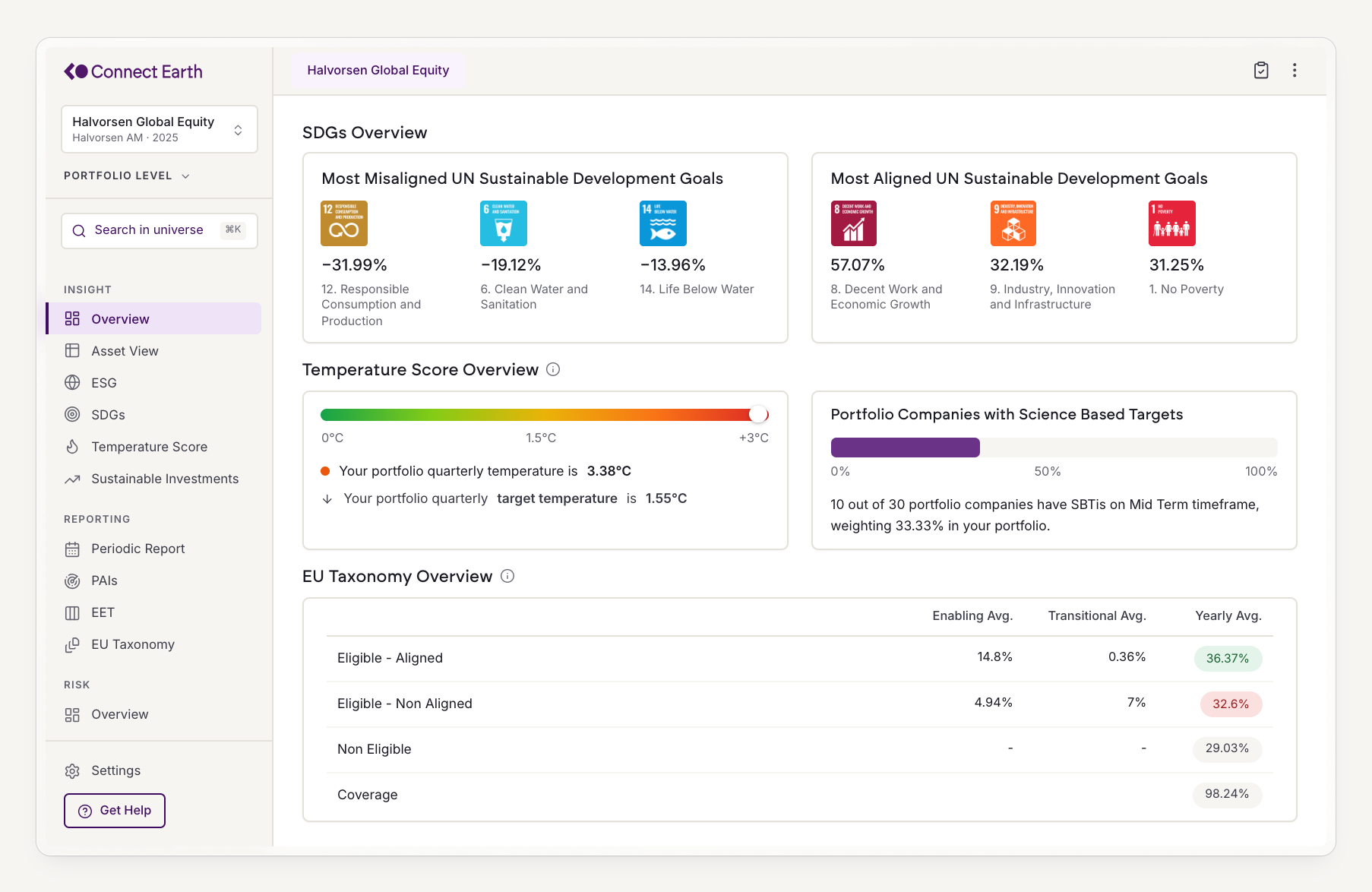
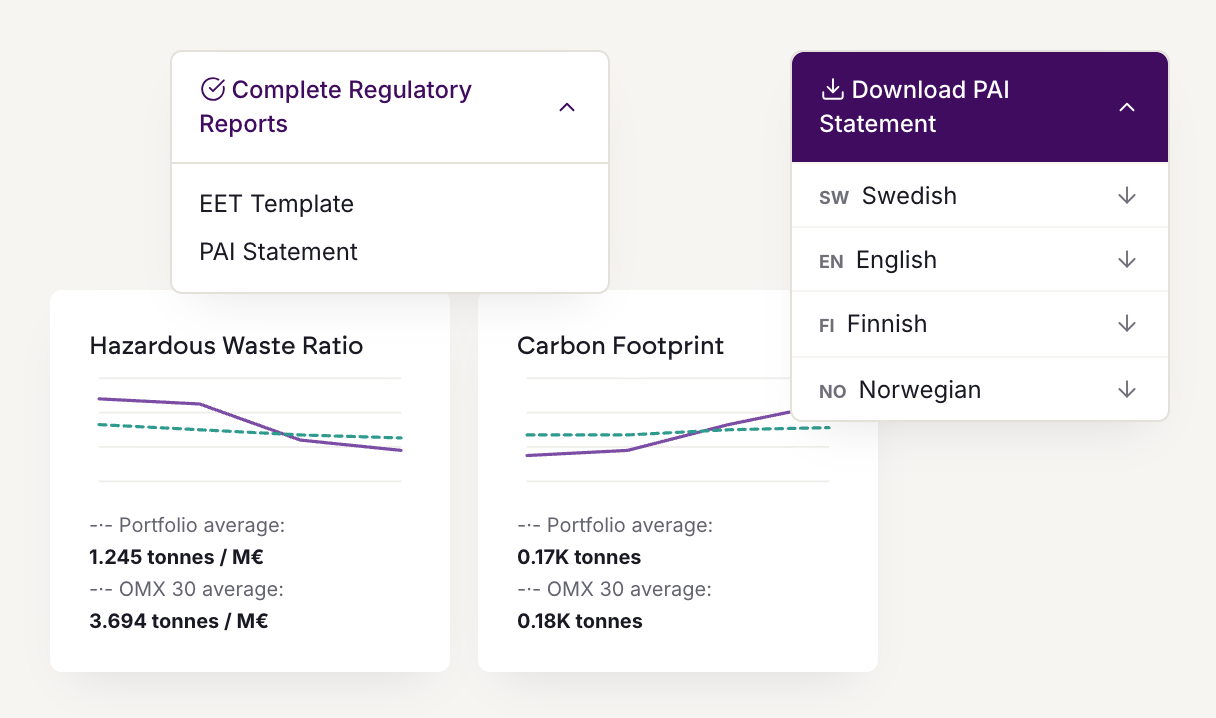
Connect Earth's Compliance and Reporting module is built to help financial institutions measure, structure, and act on sustainability data, from financed emissions to portfolio-level ESG screening, regardless of how the external ratings landscape evolves.
See how financial institutions use Connect Earth to measure, report, and act on sustainability data. Get the overview.
Your sustainability strategy deserves clarity and clear action, and we're here to help you get there. Book a meeting.