
If your team is facing increasing pressure to assess and report the carbon footprint of your investment and loan portfolios, you aren’t alone. In fact, you’re part of a global movement where Scope 3 Category 15 (Financed Emissions) is being scrutinized with the same intensity as traditional credit risk.
To put the scale in perspective: financed emissions are, on average, 700 to 750 times greater than a financial institution’s direct operational emissions. This is no longer just a "nice-to-have" ESG metric; it’s a primary indicator of your transition risk. Tracking these emissions provides a clear picture of your institution's environmental impact, but more importantly, it protects your future stability.
How can your financial institution approach this challenge in a structured, measurable way that allows you to report financed emissions as part of your future carbon accounting strategy? A strategy that is structured, measurable and defensible? Here are a few steps we recommend implementing right now.
Digging deep on the data
While most institutions start with sector averages in order to determine and estimate their impact, it’s vital to move the needle by digging deeper and transitioning to high-quality data. We recognize this is one of the hardest steps to get right; we are all navigating a "data gap" filled with imperfect reporting.
To mitigate the risk of missing or incorrect information, we recommend a transparency-first approach using the PCAF Data Quality Score. One concrete way you can implement this is by using the PCAF Data Quality Score.
What is PCAF - The Gold Standard in the Financial Sector
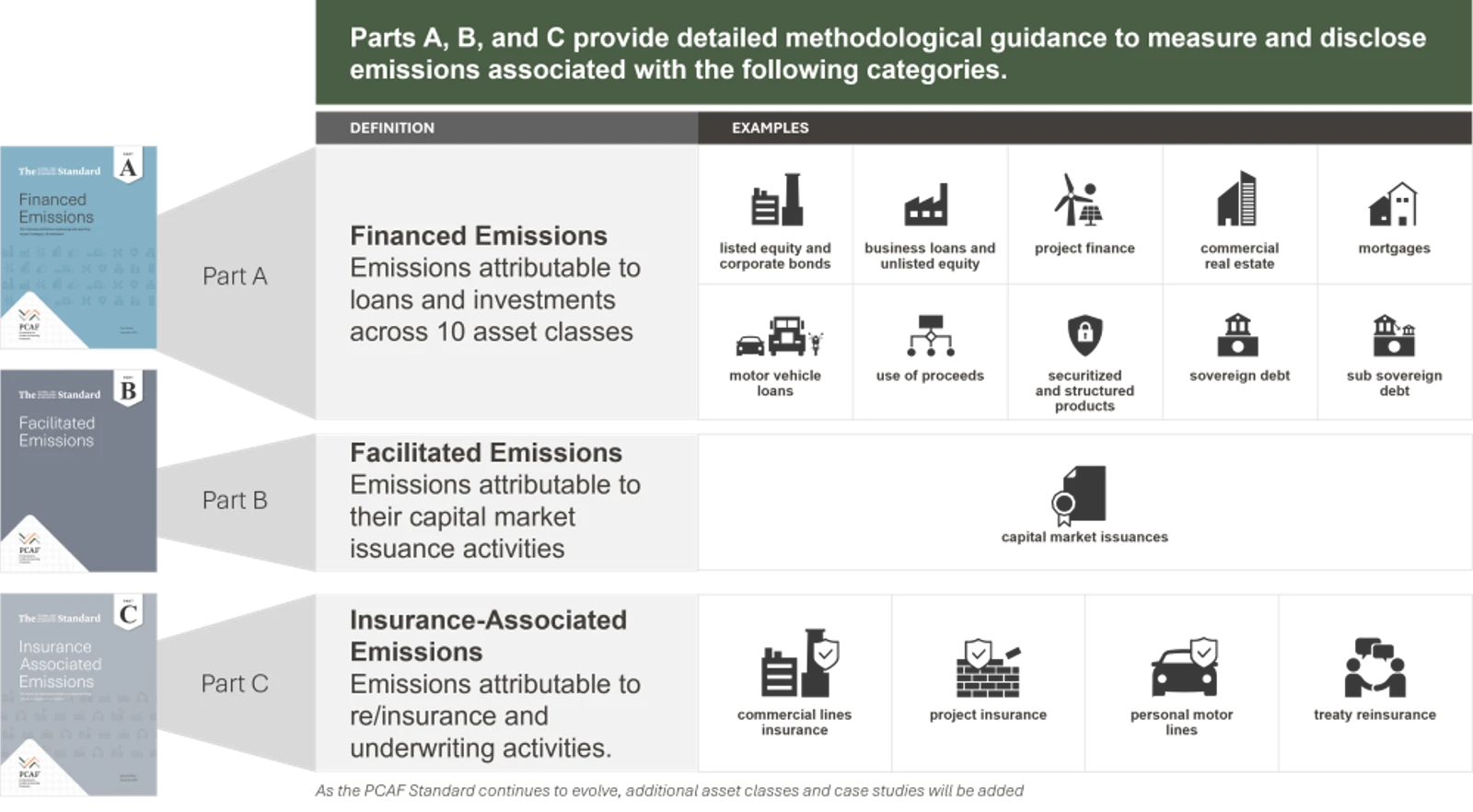
The Partnership for Carbon Accounting Financials (PCAF) provides a harmonized global method for calculating and reporting financed emissions across asset classes. A few examples of these include (but are not limited to), mortgages, project finance, corporate bonds, and motor vehicle loans. Many European financial institutions have adopted it and by understanding the PCAF guide, your institution gains a significant advantage - by utilitising this structured approach to estimate and disclose potential future climate benefits.
If financed emissions are becoming a balance-sheet issue for your institution, the next step is understanding how they can actually be measured and embedded into decision-making.
See how Connect Earth supports financed emissions.
Regularly benchmarking against averages in the sector and setting targets
Benchmarking is a good first step, but is often not enough if you’re really looking to make your strategy tangible. As of late 2025, the SBTi Financial Institutions Net-Zero Standard is the gold standard. It requires banks to set near-term (5-10 year) targets that cover a significant majority of their carbon-intensive lending.
What is the SBTi Financial Institutions Net-Zero Standard (FINZ)
FINZ is a science-based framework that requires financial institutions to set both near-term and long-term targets that align portfolios with net-zero emissions by 2050.
To build regulatory trust, your targets must move beyond aspirational dates and toward granular, science-aligned milestones. Utilizing the SBTi Financial Institutions Standard step by step correctly allows you to shift from high-level commitments to a rigorous framework backed by climate science and third-party validation.
By setting targets that cover a significant portion of your lending and investment activities rather than just operational footprints, you provide regulators with an audit-ready roadmap. This level of transparency demonstrates that your institution is not just "pledging" change, but is actively managing transition risk through measurable, time-bound pathways for every asset class in your portfolio.
Selecting the right climate tools for your carbon accounting strategy
Selecting the correct “climate stack” for your institution is essential to transforming carbon accounting from a manual burden into a strategic advantage. We are seeing a definitive shift from traditional spreadsheet-based tracking to AI-driven platforms that interconnect with internal ERP and loan management systems, significantly reducing the "heavy lifting" once required for Scope 3 Category 15 reporting. By choosing tools that offer forward-looking metrics and scenario modeling, your institution can assess the "decarbonization potential" of a client before approving a loan, helping you understand how specific investments impact your 2030 or 2050 targets in real-time.
To take your strategy to the next level, your technology must meet the rigorous requirements of the IFRS S2 Climate-related Disclosures, which mandates that disclosures be "decision-useful" and audit-ready. This requires moving away from "black box" algorithms toward platforms that provide clear visibility into emission factors and data quality, as championed by the Net-Zero Banking Alliance (NZBA). Ultimately, the goal is to internalize climate management so that your team can identify green lending opportunities and navigate transition risks with precision, rather than just fulfilling a once-a-year reporting requirement.
See how Connect Earth provides audit-ready financed emissions data.
You may ask: why go beyond simple compliance? The answer lies in the Double Materiality perspective. True thought leadership in finance means recognizing that carbon accounting isn't just about your institution's impact on the world (Impact Materiality); it's about understanding how the changing climate and shifting regulations will impact your own balance sheet (Financial Materiality).
By tackling the following steps: improving data quality with PCAF, setting science-aligned targets with SBTi, and deploying an AI-driven "climate stack", you are doing more than just reporting. You are building a more resilient institution that can identify green lending opportunities and navigate transition risks with precision. Your financed emissions data becomes a roadmap for finding the most viable, sustainable, and profitable investments of the next decade.
Do you want your emissions to generate actionable insights?
Embed gold-standard carbon data directly into your platform. Our APIs turn transactions into clear footprint calculations and actionable insights, helping you meet regulations, engage customers, and lead on sustainability.
See how financial institutions use Connect Earth to measure, report, and act on financed emissions data.
Already evaluating solutions?
Book a meeting.
Your sustainability strategy deserves clarity and clear action, and we’re here to help you get there.