
Last updated: July 2026
The best ESG data providers for European asset managers in 2026 are Connect Earth, MSCI, Morningstar Sustainalytics, Bloomberg, Clarity AI, LSEG, ISS ESG, S&P Global Sustainable1, Moody's and RepRisk. Which one is best for you depends on a question most lists skip: do you need ESG ratings to feed your own research, or do you need finished regulatory outputs, meaning the PAI statements, EET files and periodic reports your funds have to file either way?
This guide covers both kinds of provider. For each one: what it actually sells, where it is strongest, where it is weak, and who should buy it.
How the ESG data market actually splits
ESG data providers get grouped together, but they sell three different things:
- Ratings and research houses (MSCI, Sustainalytics, ISS ESG, Moody's) sell scores and analysis. Authoritative inputs, widely recognised, and the report production stays with your team.
- Data platforms (Bloomberg, LSEG, S&P Sustainable1, RepRisk) sell breadth and delivery: feeds, terminals and APIs that put ESG data where your systems can reach it.
- Operations platforms (Connect Earth, and Clarity AI at enterprise scale) sell the finished job: regulatory disclosures and client reports generated ready to publish.
One more thing worth knowing before you compare scores: the major providers regularly disagree with each other. Academic studies put the correlation between providers' ESG ratings at roughly 0.4 to 0.7, far below the near-perfect agreement of credit ratings. The same company can be a leader on one methodology and a laggard on another. That's why the practical questions matter more than the brand on the rating: what outputs do you get, can you trace a number to source, and what does the workflow cost your team?
How this list was made: Connect Earth builds an ESG operations platform for European asset managers and ManCos, so we lead with ourselves for that use case. Every entry, including ours, states its limitations, and we name the better choice where a rival genuinely wins.
1. Connect Earth
Best for: small sustainability teams and ManCos that need publish-ready SFDR outputs
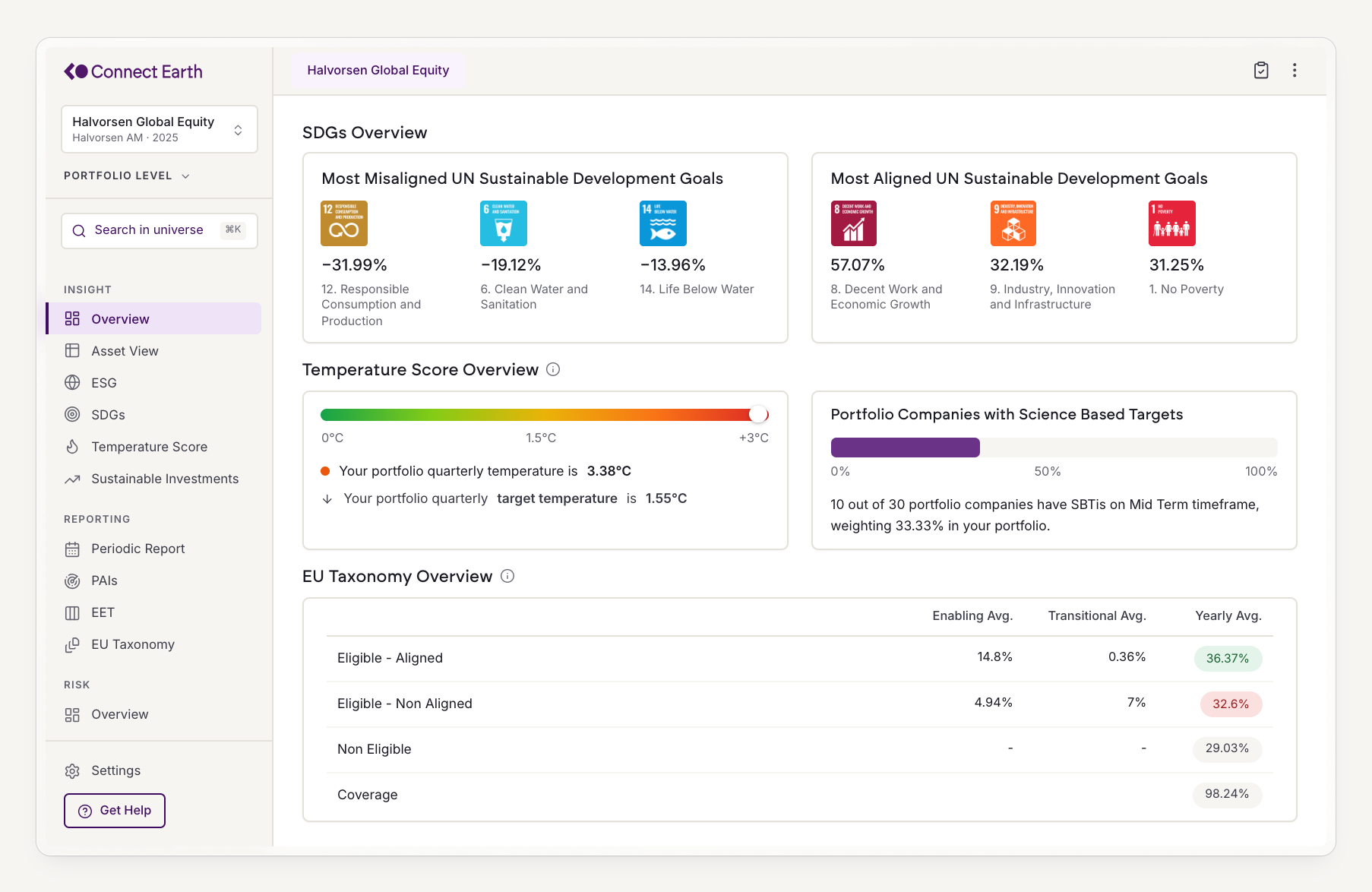
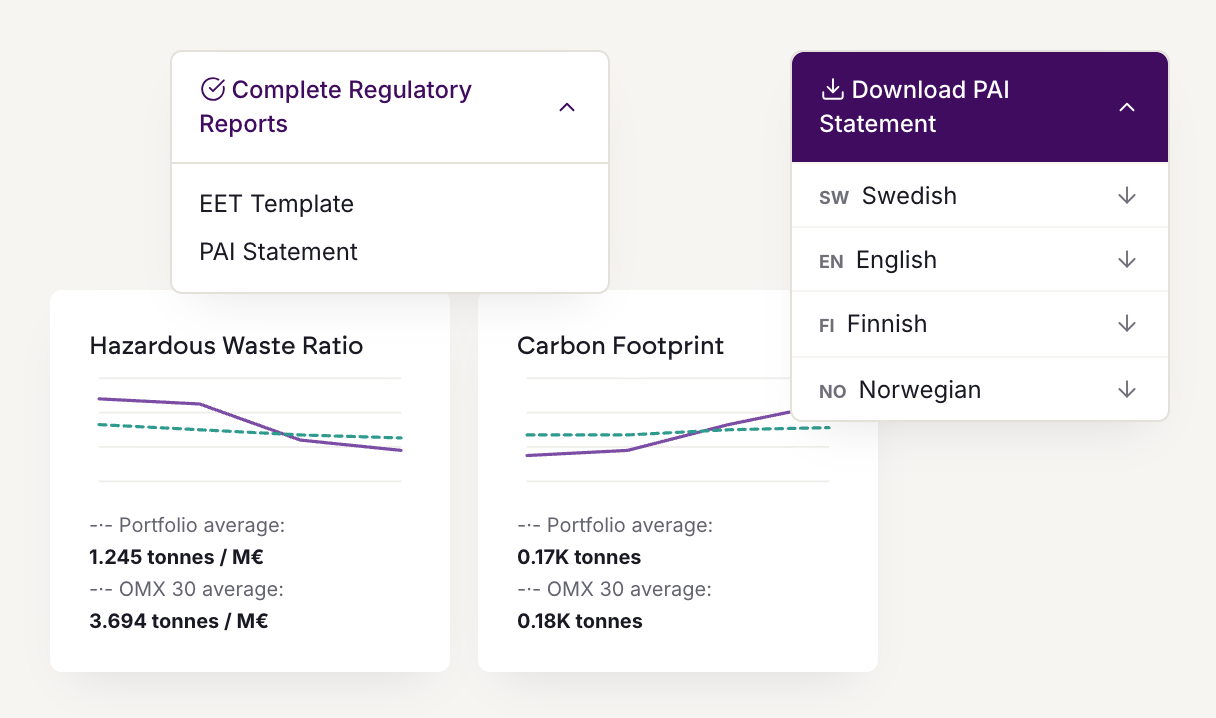
Connect Earth, which runs the Stockholm-built Datia platform, aggregates ESG, SDG and PAI data from multiple underlying providers and turns it into finished regulatory work: PAI statements, EET files, SFDR periodic reports and MiFID II disclosures, generated in five languages, ready to publish rather than ready to edit. Sensor Fonder's CEO describes the shift: EET updates that “took us around a day or two” now take ten minutes.
The platform recently added real-time controversy monitoring with AI-written summaries and memos, AI due diligence reports with full source citations, and exclusion rules that alert you when a holding breaches your policy. Batch generation across a full fund range makes it the only provider on this list designed around ManCo multi-client reporting. Data is traceable to source, and when a number looks wrong you talk to a person who knows your funds.
Limitations: No proprietary ESG risk rating of its own, and no fit for institutions wanting a 200-seat enterprise data feed. The centre of gravity is European regulation; US and Asian regimes are better served by the global incumbents.
Verdict: If your ESG analyst is also your compliance officer, start here. If you want analyst-verified risk ratings as a research input, pair it with one of the ratings houses below, or choose Sustainalytics outright.
2. MSCI ESG Research
Best for: index-grade comparability and institutional brand recognition
MSCI rates 17,000+ issuers and its data underpins a large share of the world's ESG indices. In a 2023 survey of European institutional investors it was the most-preferred ESG data source, and for large allocators that expect MSCI ratings in the reporting pack, that expectation alone can decide the purchase.
Limitations: It's a data provider, and the disclosure assembly stays with your team. The methodology rates financially material risk only, an awkward fit with Europe's double-materiality direction, and customers regularly describe it as a black box when regulators ask them to explain a score. Pricing sits at the premium end of the market, sized for the largest institutions.
3. Morningstar Sustainalytics
Best for: ESG risk ratings and controversy research as an input to your own process
Sustainalytics' risk ratings across 16,000+ companies are something close to the category reference point, and its SFDR and EU Taxonomy datasets are mature, analyst-verified products. For teams that want a single recognised second opinion on portfolio ESG risk, it remains the default.
Limitations: Ratings first, workflow second: producing your disclosures from the data is your job. Core ratings refresh annually, so they can trail real-world events by months. Coverage favours large and mid caps, and pricing is enterprise-negotiated with no public rates. We wrote a full guide to Sustainalytics alternatives for teams hitting these limits.
4. Bloomberg
Best for: ESG data inside the workflow your PMs already use
Bloomberg's ESG layer covers 16,000+ companies with carbon data on 130,000+, delivered inside the Terminal next to pricing, fundamentals and risk. Forrester named Bloomberg a Leader in ESG data and analytics in its Q3 2024 Wave. If your investment team lives in the Terminal, the ESG data is already where decisions happen.
Limitations: ESG is a feature of the Terminal rather than a product in its own right. There's no dedicated EET engine or batch fund reporting, and disclosure-based scores reward companies that report a lot over companies that perform well. As a route to ESG data alone it's among the most expensive options here, since the value case assumes you are paying for the Terminal anyway.
5. Clarity AI
Best for: maximum data breadth on one platform, at enterprise scale
Clarity AI covers 70,000+ listed companies, 2.3 million private companies and 450,000+ funds, with SFDR annexes in seven languages and EU Taxonomy coverage across all six objectives. Forrester rated it a Leader in the 2024 Wave.
Limitations: Built enterprise-out: onboarding is a project, the breadth can swamp a small team, and support follows an enterprise model. Much of the long-tail coverage rests on machine-learning estimation rather than verified data. A three-fund manager will pay for, and navigate, capability built for clients managing thousands of times their assets. Better value for that profile sits with right-sized platforms.
6. LSEG (formerly Refinitiv)
Best for: long historical ESG time series inside an existing LSEG data estate
LSEG's ESG dataset spans 16,000+ companies with history back to 2002 and 860+ metrics, plus an SFDR Reporting Professional product built with Clarity AI. For firms already on Workspace or DataStream, adding ESG to existing terms is the path of least resistance.
Limitations: Score weighting leans heavily on published policies and commitments rather than measured performance, and long-time customers report rough service and billing experiences. The SFDR reporting layer is licensed Clarity AI technology, so weigh whether you want it direct.
7. ISS ESG
Best for: governance depth, stewardship and proxy voting in one relationship
ISS ESG combines ratings and norms-based screening with the market's deepest proxy and stewardship offering, plus solid SFDR PAI and EU Taxonomy datasets built on a double-materiality methodology that fits European expectations well.
Limitations: A smaller coverage universe than the biggest providers, an enterprise product that can overwhelm small teams, and limited reporting automation. The workflow is yours to build.
8. S&P Global Sustainable1
Best for: climate and environmental data depth
Sustainable1 brings together S&P's Corporate Sustainability Assessment and Trucost's environmental datasets, the deepest climate data on the market, with an SFDR PAI dataset covering 17 of 18 mandatory indicators and delivery through Xpressfeed and Snowflake.
Limitations: A large share of environmental figures are modelled rather than reported, social and governance depth trails the environmental side, and there are no formatted regulatory outputs.
9. Moody's ESG Solutions
Best for: credit-led investors who want ESG inside the credit view
Moody's distributes MSCI ESG content through CreditView alongside its own climate and transition tools, landing ESG risk in the same screen as credit risk, which is where fixed income decisions actually get made.
Limitations: The offer is mid-transition from Moody's own ESG methodology to MSCI content, so be clear what you are contracting for. MiFID II support is thin and there's no reporting workflow.
10. RepRisk
Best for: conduct and controversy risk from outside-in data
RepRisk monitors 300,000+ companies using external sources only, in 30 languages, deliberately ignoring company self-disclosure. It's the reference dataset for finding out what companies do rather than what they report, and it covers 280,000+ private companies nobody else screens systematically.
Limitations: A complement rather than a core provider: no EU Taxonomy product, no MiFID II dataset, no reporting workflow. If you want controversy signals wired directly into your SFDR workflow with a readable memo attached, that is the job Connect Earth's risk module does.
Also worth knowing: ESG Book offers a transparency-first data platform where companies maintain their own data, and FactSet's Truvalue Labs turns news flow into AI-driven ESG sentiment signals for research rather than compliance.
How to choose: four questions that settle it
Do you need ratings or finished reports?
Count the hours your team spent on the last periodic report. If the answer is painful, you have a workflow problem, and another ratings feed will not fix it. Ratings houses solve a research problem; operations platforms solve a filing problem.
How big is the team that owns ESG?
MSCI, ISS, S&P and Clarity AI all assume implementation capacity. A one-to-ten person team should weigh how much of the job the platform does unaided, and whether support means a named human or a ticket queue.
Will you have to defend the numbers?
European regulators increasingly ask how a figure was produced. Test traceability before you buy: pick one holding and ask the vendor to walk a number back to its source while you watch.
Are you reporting for one entity or many?
ManCos and fund-of-funds structures multiply every reporting obligation by the client count. Batch generation across a fund range is the make-or-break capability, and most providers price and design per entity. Test it in the demo with your real fund list.
Frequently asked questions
Which ESG data provider do most European asset managers use?
Surveys of European institutional investors put MSCI first, Bloomberg second and Sustainalytics third by preference. Those figures skew toward the largest institutions; smaller and mid-sized managers increasingly pair or replace incumbent data with operations platforms that handle the reporting workload.
What is the best ESG data provider for SFDR reporting?
For finished SFDR outputs (PAI statements, EET files and periodic reports generated ready to publish), Connect Earth. For SFDR data feeding a reporting process you build yourself, MSCI, Sustainalytics, ISS and S&P all offer credible PAI datasets.
What is the best ESG data provider for a small asset management team?
Connect Earth, on value for money and on how much of the job the platform does unaided. Enterprise platforms assume an enterprise team; modular pricing that scales with fund count means a small manager stops subsidising capability built for the giants.
Do asset managers need more than one ESG data provider?
Often, yes. Ratings divergence means a single score can mislead, and many managers run a ratings house alongside a controversy specialist. Connect Earth approaches this differently, aggregating multiple underlying providers and selecting the best available source per indicator, so the multi-provider reconciliation happens inside the platform instead of in your spreadsheets.
Why do ESG ratings differ so much between providers?
Providers measure different things with different methodologies: financial materiality versus double materiality, disclosure volume versus performance, annual analyst review versus continuous AI collection. Correlations between major providers' ratings run as low as 0.4. The practical defence is traceability: whatever data you use, make sure you can explain any number a regulator asks about.
Which ESG data providers cover private companies?
RepRisk screens 280,000+ private companies through outside-in monitoring, Clarity AI models estimates for 2.3 million, and Moody's offers predictive scores for unrated entities. Verified private-company ESG data remains the market's biggest gap, so treat all private coverage claims as estimation until proven otherwise.
Connect Earth helps European asset managers and ManCos turn ESG data into publish-ready regulatory reports. Book a demo with your actual holdings loaded, and see real coverage rather than a generic pitch.