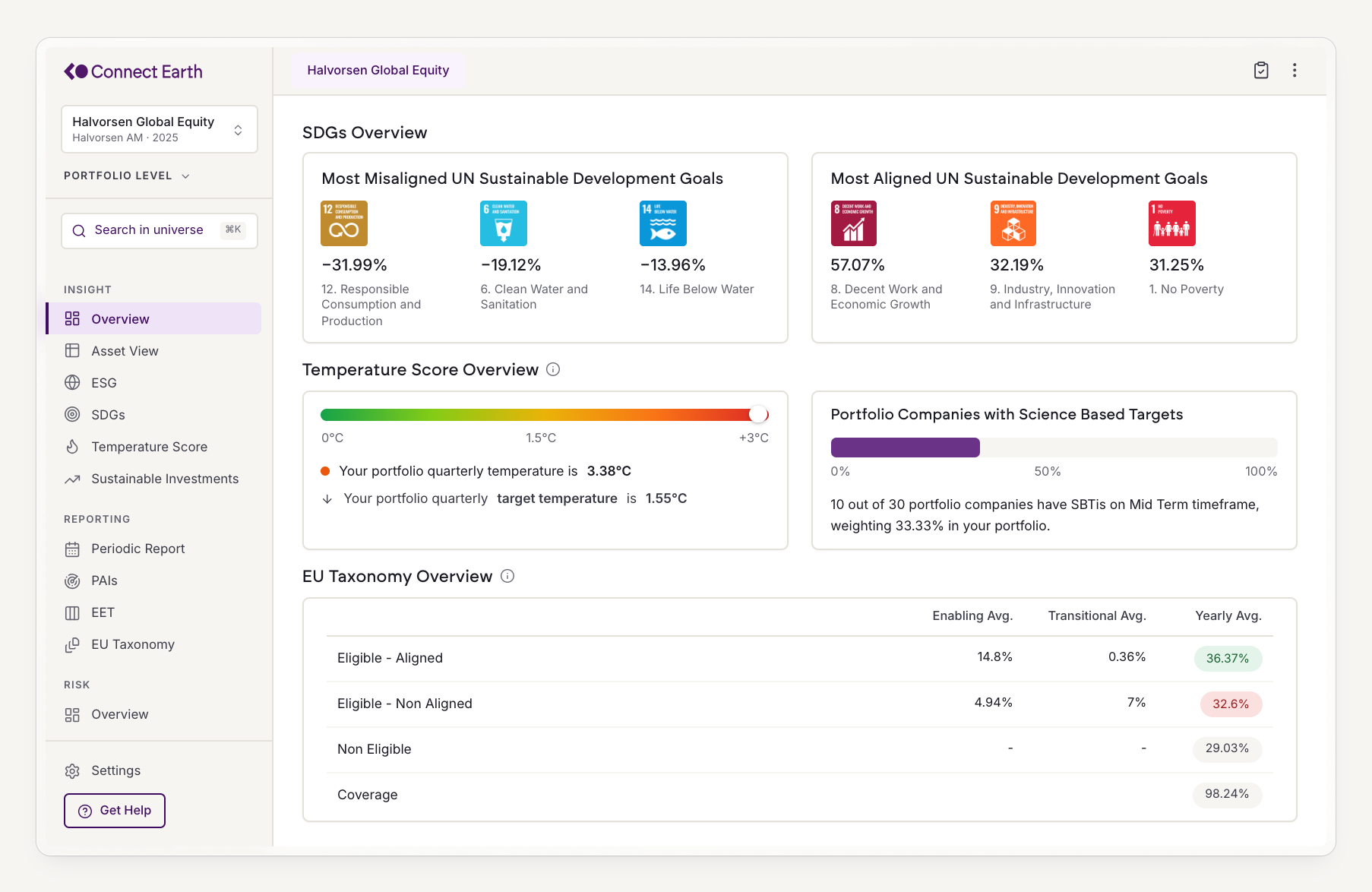
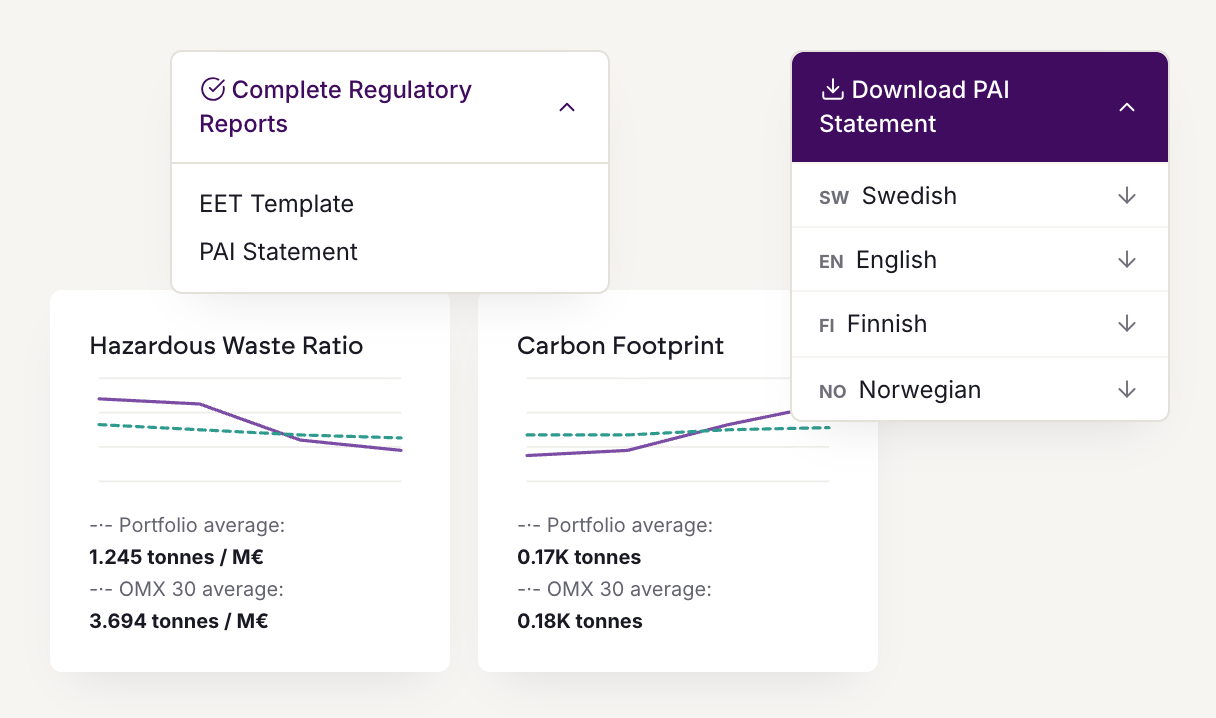

As management companies grow, each new fund client adds additional ESG reporting work. EET files, PAI statements, periodic reports, each with their own templating quirks, and potentially an entirely new review chain.
In this article we'll cover where we see gaps in how ESG platforms solve for these issues today, and provide some insight into what we've seen work best in practice.
Where ManCos face challenges with common ESG tooling
Many ESG platforms on the market are designed around a single asset manager reporting on their own funds. Often, multi-client workflows are treated as an edge case, which presents issues in three ways:
- Pricing is per fund: each client you onboard costs marginally more to serve than the last, which is not helpful for a business serving many clients from one operational base.
- Reporting is built one fund at a time: fine when you run just a small number of funds but harder when you oversee 40 across a dozen clients, each needing the same disclosure in a slightly different format.
- Outputs carry the platform's identity: this is a problem if ESG reporting is something you want to sell as your own service.
Sustainalytics, ISS, MSCI and Bloomberg are data businesses. Clarity AI is built enterprise-out, for firms managing trillions. The multi-entity, batch-processing, white-labellable workflow a ManCo needs most is not the use-case they're typically optimised for.
The day to day tasks that matter
When speaking to Heads of Sustainability at ManCos we see the workload fall into four recurring themes.
- Produce disclosures across every client fund: EET files, PAI statements, SFDR Periodic Reports, all required to strict regulatory deadlines. Whilst the work often scales almost linearly with additional clients as you grow, we're hearing that team size is often not growing to match.
- Chase sub-advisors: Tracking down the data you rely on for disclosures, or to double check figures, consumes a lot of time. Chasing happens across email and instant messaging with no central record of who has responded, and who needs chasing first.
- Answer DDQs before a fund can be listed: distributors, banks, IFAs and institutional allocators want to understand how a fund is classified before it goes on their platform. Effective distribution relies on being able to respond to these requests succinctly and quickly, without adding additional strain to a stretched team.
- Be the single point of accountability: Even with a large number of funds under management there may only be a one or two person team answerable for them all. Sitting on sustainability committees, supporting sales meetings, and keeping track of all activities combined is no easy task.
Edward Svensson, Deputy Head of Back Office at FCG Fonder: “It can be very challenging to manage funds sustainably without a platform like Connect Earth.”
How a purpose-built tool can help
Generally the super-power of a purpose-built tool is to get away from per-fund actions and towards something aggregated across multiple funds. A good ManCo platform helps you abstract your time and effort, focusing on re-usable templates and artefacts which multiply your impact across funds.
- Generate in batches: you select a group of funds, assign templates by category, and generate the whole set in one operation. Saved groupings mean you define “Article 8 equity funds for Client A” once and reuse it every quarter.
- Cascade updates from a master template: most ManCos maintain somewhere between 10 and 20 template variants by hand. When an auditor sends a late comment, that comment has to be replicated across every affected fund, often to tight deadlines. With a master template you edit once, preview what will change, and cascade it. You'll no longer fear the last minute audit comment on a highly specific detail.
- Control the overrides: the funds that deviate keep their overrides when the master template updates, and every override is logged. Now an exception is more manageable, rather than an untracked liability.
- Review and approve in one place: multi-stage approval chains, section-level comments, status tracking, and restricted external sharing, so an auditor can see what they need without getting access to everything else. This makes a huge difference in comparison to the typical email and shared-drive processes.
- Keep a complete audit trail: version history, a paper trail recording every edit, upload, approval and override. When a client or a regulator asks how a disclosure was produced you can rest assured that the response is easy to prepare based on the facts collected by the system along the way.
Where screening and monitoring fit in
Reporting tends to be the work that gets recognised first, because it arrives with deadlines attached. Two other tasks take up a similar amount of time, and in our experience they get less attention.
The first is pre-investment screening. Before a fund commits to a position, whether that's a listed equity or a private company with very little public disclosure, someone needs to pull the ESG and risk metrics together, check them against the relevant exclusion policies, and produce a due diligence report the investment committee can rely on. For a ManCo overseeing client funds rather than running its own book, that work repeats for every deal and across every client, often with each client's own policy variations layered on top. Done by hand, an analyst is rebuilding much the same research process each time, and there is little guarantee that two analysts would arrive at the same answer.
The second is ongoing monitoring. A holding that passed screening on day one won't necessarily stay that way. Policies get breached, controversies emerge, and a company's practices shift over time. Ideally you'd hear about it the day it happens rather than the day a client asks, which means alerts that reach a person rather than a dashboard someone has to remember to check. Across dozens of client mandates with no central view, we're hearing that this is very difficult to do consistently.
Both of these can be approached in much the same way as batch reporting. Data collection and risk screening can run across public and private companies alike, due diligence reports can be assembled by the system rather than built in Excel, and policy-based alerts can flag a breach when it happens rather than at the next scheduled review. The time saved matters, but most importantly it means you can tell a client that every one of their funds is screened and monitored to the same standard, whichever analyst happens to be covering it.
How the commercial picture can change
For most ManCos, ESG services currently sit on the cost side of the ledger. It is overhead attached to winning mandates.
It doesn't necessarily have to stay there. Once reporting is genuinely batch-capable and priced modularly rather than per fund, two things become possible.
- Each additional fund can cost less to serve than the last: growth then starts to improve your margin rather than eroding it, and taking on a new mandate stops feeling expensive.
- ESG services become something you can package and charge for: we're already seeing ManCos offer this to their clients as a value-added service. Being able to tell a prospective client “we handle your SFDR reporting, your EET files and your periodic disclosures” is worth a lot to them, and it is something they would otherwise have to go and buy separately.
Where to start
A few things are worth doing before you evaluate any platform.
- Count your actual template variants: in our experience most teams find the number is higher than they expected, and it is usually a good indicator of how much a master-template approach can save you.
- Map how many separate systems a single disclosure passes through today, from data source to signed document. Every handoff is somewhere time and errors can accumulate, and the map is what you'll use to judge whether a platform genuinely shortens the chain or just adds another link to it.
- Look at how consistently screening and monitoring happen across your client funds: if the answer depends on which analyst is covering which fund, that tends to be the gap a centralised system closes first.
One ManCo we work with now generates EET files for 12 client funds in a single run. That used to take them about a week, and it is now part of what they sell to their own clients.
Curious what this looks like for your client funds? We'll load a real fund group and show you a batch run, so you can see how this would work across your own funds rather than sitting through a generic demo. Book a demo