
Last updated: August 2026
The leading alternatives to Sustainalytics in 2026 are Connect Earth, Clarity AI, MSCI ESG Research, S&P Global Sustainable1, Bloomberg, ISS STOXX (formerly ISS ESG), LSEG, Moody's, RepRisk and EthiFinance (formerly ESG Book). Most teams that look beyond Sustainalytics still rate the research itself. What sends them looking is everything that happens after the data arrives: turning raw scores into PAI statements, EET files, periodic reports and client updates, usually by hand, usually in Excel.
This guide compares all 10 alternatives on the things buyers actually decide on: whether you get publish-ready regulatory outputs or raw data, how controversy monitoring works, how the data is delivered, and what the pricing model looks like. It also tells you when Sustainalytics is still the right choice, because for some teams it genuinely is.
Why teams look beyond Sustainalytics
Morningstar Sustainalytics is one of the most established names in ESG research, with risk ratings across 16,000+ companies and a dedicated analyst team. The reasons teams go looking elsewhere tend to be practical rather than reputational:
- Ratings first, workflow second. Sustainalytics delivers scores and data points. Producing an SFDR periodic report, an EET file or a client-ready fund report from them is still your team's job.
- An annual research cycle. Core risk ratings run on a yearly research cycle. Event-driven adjustments happen in between, but the full picture behind a rating is revisited once a year, so between cycles you are working with a snapshot.
- Coverage that favours large and mid caps. The methodology is strongest where disclosure is richest. Teams holding small caps or private names often find the depth thins out exactly where they need it most; private-company coverage is growing, but remains far shallower than listed large caps.
- Enterprise pricing, unpublished rates. There is no public price list, subscriptions are scoped and negotiated per use case, and licensing restricts how the data can be redistributed. Smaller asset managers regularly report paying for far more breadth than they use.
- A regime built for yesterday's rules. The EU's SFDR review, widely called SFDR 2.0, is set to replace the Article 8/9 labels with evidence-backed product categories. When it applies, firms will need to show why each fund sits in its category, not just file a disclosure. An annual rating you cannot trace to source is a weak foundation for that.
If none of these bite, stay put. If one or more of them describes your quarter-end, here are the 10 alternatives worth evaluating.
Comparison at a glance
- Connect Earth — ESG operations platform. Publish-ready SFDR outputs: Yes: PAI, EET, periodic, MiFID II, in 5 languages. Controversy monitoring: Real-time, with AI summaries and memos. Delivery: Platform + API + export/sync. Pricing model: Modular, scales with fund count.
- Clarity AI — AI-powered sustainability data platform. Publish-ready SFDR outputs: Yes: SFDR annexes, templates. Controversy monitoring: Yes, NLP-based. Delivery: Platform + API + MCP. Pricing model: Enterprise, custom quote.
- MSCI ESG — Ratings and index-grade data. Publish-ready SFDR outputs: Data feeds; reporting services as enterprise add-on. Controversy monitoring: Flags within ratings. Delivery: Feeds + platform. Pricing model: Enterprise, custom quote.
- S&P Sustainable1 — Climate and ESG datasets (incl. Trucost). Publish-ready SFDR outputs: Datasets + EET field mapping, not formatted reports. Controversy monitoring: Limited. Delivery: Feeds (Xpressfeed, Snowflake). Pricing model: Enterprise, custom quote.
- Bloomberg — ESG layer inside the Terminal. Publish-ready SFDR outputs: Templates within PORT. Controversy monitoring: News-driven, manual workflow. Delivery: Terminal + data licence. Pricing model: Per seat (~$32k/year).
- ISS STOXX — Ratings, screening and stewardship. Publish-ready SFDR outputs: PAI and Taxonomy datasets. Controversy monitoring: Norms-based flags. Delivery: Feeds + platform. Pricing model: Enterprise, custom quote.
- LSEG — ESG scores and regulatory data. Publish-ready SFDR outputs: SFDR Reporting Professional (with Clarity AI). Controversy monitoring: Within news ecosystem. Delivery: Workspace + feeds. Pricing model: Enterprise, custom quote.
- Moody's — Credit analytics + MSCI ESG content. Publish-ready SFDR outputs: Via MSCI datasets, no formatted reports. Controversy monitoring: Within credit research. Delivery: CreditView + feeds. Pricing model: Enterprise, custom quote.
- RepRisk — Outside-in ESG risk intelligence. Publish-ready SFDR outputs: PAI inputs via ICE partnership. Controversy monitoring: Best-in-class, daily, 100 languages. Delivery: Feeds + API. Pricing model: Enterprise, custom quote.
- EthiFinance (ESG Book) — Data and disclosure platform (merged Jul 2026). Publish-ready SFDR outputs: Workflow support, no dedicated EET/PAI engine. Controversy monitoring: NLP-based. Delivery: Platform + API. Pricing model: Subscription, custom quote.
A note on how this list was made. Connect Earth builds an ESG operations platform for European asset managers and fund management companies, so we have listed ourselves first for that use case. We have also been specific about where each alternative beats us, and where Sustainalytics remains the better fit. A comparison you cannot trust is not worth your reading time.
1. Connect Earth
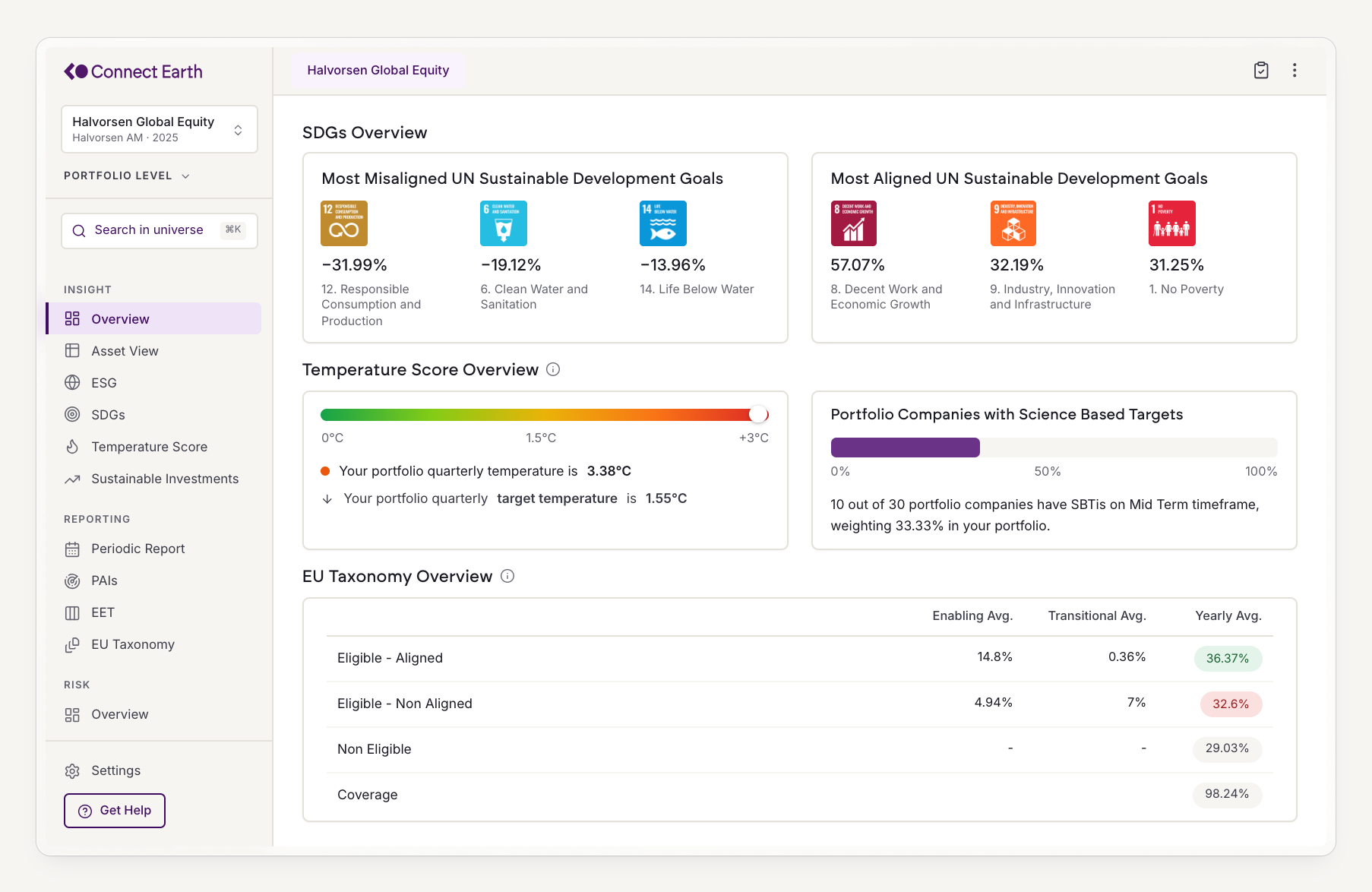
What it is: An ESG operations platform for asset managers and ManCos. Connect Earth (which acquired and now runs the Stockholm-built Datia platform) aggregates ESG, SDG and PAI data from multiple underlying providers and turns it into regulatory disclosures and client reports that come out ready to publish, not ready to edit.
Key capabilities:
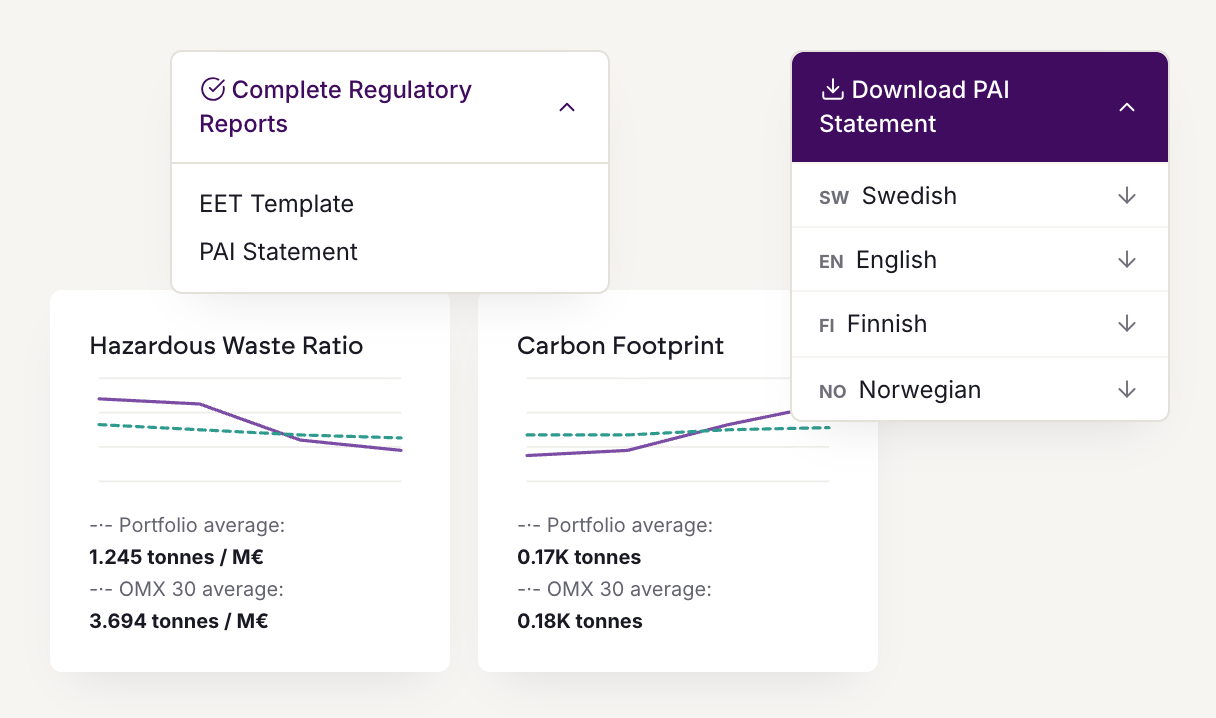
- PAI statements, EET files, SFDR periodic reports and MiFID II disclosures generated in five languages
- Batch periodic reporting across an entire fund range: master templates you edit once and cascade to every linked report, review and approval workflows, and a full audit trail
- Real-time controversy monitoring with AI-generated plain-language summaries and memos
- AI due diligence reports with full source citations, generated per company on demand
- Screening that applies your own investment policy, with automatic alerts when a holding breaches it
- Plain-language metric explanations and change monitoring, rolling out now, so you can trace any number back to its source and methodology
- Configurable questionnaires for collecting ESG data directly from private and unlisted holdings, with automated reminders, rolling out now
- Export and sync into the spreadsheets and systems your team already works in
Strengths: The platform does the assembly work that raw data providers leave with your analysts. Philip Karlberg, CEO of Sensor Fonder, puts it plainly: updating EET files "took us around a day or two. With Connect Earth, we can update our files in just ten minutes." Data is traceable back to source, and when a number looks wrong you get a call with the team, with a person who knows your funds, rather than a ticket queue. Pricing is modular and scales with your fund count, so a three-fund manager pays for what a three-fund manager uses. Against incumbents priced for the largest institutions, the value for money is the point.
Limitations: Connect Earth does not produce its own proprietary ESG risk rating, and it is not built for institutions that want a 200-seat enterprise data feed. Its regulatory depth is built around EU regimes (SFDR, EET, MiFID II); if your reporting centres on Asian frameworks today, the incumbents are further along there.
Best for: European asset managers with small sustainability teams, and ManCos reporting across many client funds. Choose Sustainalytics instead if what you need is analyst-verified ESG risk ratings as an input to your own research process.
2. Clarity AI
What it is: An AI-powered sustainability platform covering 98,000+ issuers, 2.3 million private companies and 450,000+ funds, with strong SFDR, EU Taxonomy and MiFID II modules.
Key capabilities: SFDR annex templates in seven languages, EU Taxonomy across all six objectives, NLP-based controversy detection, broad API access, and since July 2026 an MCP connector that brings its screening into AI assistants.
Strengths: On paper, the most capable pure-play ESG data platform. Forrester named it a Leader in its Q3 2024 Wave for ESG data and analytics, and its regulatory coverage is genuinely deep. Source-linked data points distinguish reported from estimated values.
Limitations: Built for enterprise scale, and it shows: onboarding is a project, the feature breadth can be overwhelming for a small team, and support follows an enterprise model. Much of the small-cap and private-company coverage relies on machine-learning estimation rather than verified data. Pricing is custom and aimed at institutional budgets.
Best for: Mid-to-large asset managers who want maximum data breadth on one platform and have the team to run it. Choose Connect Earth instead if your ESG analyst is also your compliance officer and what you need out of the door is finished reports rather than faster access to data.
3. MSCI ESG Research
What it is: The most widely recognised name in ESG ratings, covering 17,000+ issuers, with data that underpins a large share of the world's ESG indices.
Key capabilities: Industry-relative ESG ratings, SFDR PAI metrics, EU Taxonomy data, MiFID II classification tools, index-grade delivery infrastructure.
Strengths: Unmatched brand recognition and comparability across portfolios. If your institutional clients expect MSCI ratings in the deck, that alone can settle the decision.
Limitations: A data business first: reporting templates and services exist as an enterprise add-on, but the centre of gravity is feeds, and the formatted disclosure work largely stays with your team. The methodology rates financially material risk only, which sits awkwardly with the EU's double-materiality direction. Customers have long described the methodology as a black box; the v5.0 model that went live in March 2026 adds score traceability in response, and changed scores for roughly a third of issuers in the process. And pricing is among the steepest in the category: publicly disclosed fees run from thousands to millions of dollars a year, with the packages relevant to institutional buyers at the enterprise end, so a smaller manager ends up paying for thousands of issuers they will never look at.
Best for: Large institutions that need index-grade comparability and have the budget and team to build their own reporting on top.
4. S&P Global Sustainable1 (including Trucost)
What it is: S&P's sustainability arm, combining Corporate Sustainability Assessment scores with Trucost's environmental and climate datasets across 18,000+ listed companies.
Key capabilities: SFDR PAI dataset covering 17 of 18 mandatory indicators, EU Taxonomy mapping, sector-leading climate and carbon analytics, delivery via Xpressfeed and Snowflake.
Strengths: Some of the strongest environmental and climate data on the market. The estimation model fills disclosure gaps systematically, and the data plugs neatly into quant workflows.
Limitations: For a majority of covered companies the environmental figures are modelled rather than reported; independent research puts the modelled share at roughly three quarters. Social and governance depth lags the environmental side. And while an EET field-mapping solution exists, there are no formatted regulatory reports: this is a dataset business, and the reporting workflow is yours to build.
Best for: Climate-focused institutional investors who want rigorous environmental data feeding their own infrastructure.
5. Bloomberg ESG
What it is: ESG data as a layer inside the Bloomberg Terminal, covering 16,000+ companies, with PAI data and SFDR templates inside Bloomberg PORT.
Key capabilities: ESG alongside pricing, fundamentals and risk in one workflow, carbon data on 130,000+ companies, MiFID II preference data.
Strengths: If your PMs live in the Terminal, the ESG data is already where they work. No new system, no integration project.
Limitations: ESG is a feature of the Terminal rather than the product. Bloomberg supplies EET input data and distributes fund-reported EET files, but nothing generates the template for you, and there is no batch fund reporting. The scores are built solely on company-disclosed data, so thin disclosure drags a score down regardless of how the company actually performs. And the economics only work if you already pay roughly $32,000 per seat per year.
Best for: Terminal-native firms that want ESG context inside the investment workflow and handle regulatory reporting elsewhere.
6. ISS STOXX Sustainability (formerly ISS ESG)
What it is: The sustainable investment arm of ISS STOXX, wholly owned by Deutsche Börse since March 2026 and rebranded from ISS ESG in April 2026. It combines ESG ratings, norms-based screening and the deepest proxy-voting and stewardship offering in the market.
Key capabilities: Regulatory datasets (SFDR PAI, EU Taxonomy) covering up to 64,500 issuers, corporate ESG ratings on 8,200 companies, granular governance scoring, double-materiality methodology.
Strengths: Governance and stewardship depth nobody else matches, and a methodology that aligns well with EU double-materiality expectations.
Limitations: The rated-company universe (8,200 corporates) is smaller than the biggest providers', even though its screening and climate datasets reach much further. The investor-side regulatory offering is data delivery: ISS supplies the datasets and the disclosure workflow is yours. And it is an enterprise-grade product that can overwhelm small teams.
Best for: Institutional investors whose ESG strategy centres on engagement, voting and stewardship.
7. LSEG ESG (formerly Refinitiv)
What it is: ESG scores and regulatory datasets covering 16,000+ companies with history back to 2002, part of the London Stock Exchange Group data estate. In March 2026 LSEG launched a rebuilt product, LSEG Sustainability Ratings and Data, with the long-standing ESG Scores moving to legacy status over a transition period.
Key capabilities: The new ratings suite (220 indicators on a rules-based 0 to 5 scale, double materiality, ISSB-aligned), the legacy scores' 860+ ESG metrics and long time series, SFDR Reporting Professional (built with Clarity AI), EU Taxonomy data, delivery through Workspace, DataStream and cloud platforms.
Strengths: Long historical time series and broad metric coverage, with natural appeal for firms already running LSEG market data. The 2026 methodology rebuild is a genuine response to criticism of the old scores.
Limitations: The legacy scores weighted policies and commitments over measured performance (independent research put roughly 60% of the weighting on aspirational features), which is exactly what the new methodology sets out to fix. If you are evaluating LSEG, be clear which product you are being sold and how long the legacy scores will be supported. Reviewers of LSEG's broader data business also report difficult service and billing experiences. The SFDR reporting product is licensed Clarity AI technology, so consider whether you want it direct.
Best for: Firms embedded in the LSEG data stack that want ESG added to existing terms.
8. Moody's (with MSCI ESG content)
What it is: ESG content delivered through Moody's credit franchise. Moody's exited proprietary ESG scoring after its 2024 partnership with MSCI: since January 2025, MSCI ESG ratings and controversy data have replaced Moody's own assessments inside CreditView, alongside Moody's climate and credit analytics.
Key capabilities: MSCI ESG ratings and controversies within CreditView, climate-adjusted credit analysis, private-credit risk assessments built with MSCI.
Strengths: The credit integration is genuinely useful for fixed income teams: ESG risk lands in the same view as credit risk, where bond investors actually make decisions. And the transition question is settled: what you are buying is unambiguously MSCI ratings content plus Moody's credit and climate tools.
Limitations: The ESG ratings content is MSCI's, so you inherit MSCI's methodology and its financial-materiality lens, with Moody's as the distribution layer. There is no native MiFID II dataset and no formatted regulatory reporting; SFDR needs are served through MSCI's datasets rather than anything Moody's-built.
Best for: Credit-led investors already inside the Moody's ecosystem who are comfortable with MSCI as the ratings source.
9. RepRisk
What it is: Outside-in ESG risk intelligence on 350,000+ companies, around 80% of them private, built entirely from external sources (news, NGO reports, regulatory filings, in 100 languages) rather than company disclosures.
Key capabilities: Daily controversy and conduct risk screening, nearly two decades of consistent methodology with data back to January 2007, PAI inputs through its ICE partnership.
Strengths: The reference standard for finding out what companies do rather than what they say. Because it ignores self-disclosure entirely, it catches conduct issues that disclosure-based ratings structurally miss. In July 2026 FactSet named RepRisk its preferred partner for business conduct risk data, which tells you how the market rates it.
Limitations: A complement, not a primary provider: there is no EU Taxonomy product, no MiFID II dataset and no reporting workflow. You will still need a core ESG data and reporting solution alongside it. RepRisk flags allegations without verifying them, so the signal needs interpretation.
Best for: Teams adding a conduct-risk layer on top of an existing ESG data setup. (If what you want is controversy monitoring that feeds straight into your SFDR workflow with a written memo attached, that is the gap Connect Earth's risk module was built to close.)
10. EthiFinance (formerly ESG Book)
What it is: ESG Book merged with EthiFinance in July 2026, forming one of Europe's larger independent credit and sustainability rating agencies under the EthiFinance brand. The platform side brings ESG Book's dataset of 76,000 companies; the agency side brings EthiFinance's European credit and sustainability ratings.
Key capabilities: Real-time score updates, regulatory tracking across 100+ jurisdictions, private data collection for unlisted holdings, API delivery.
Strengths: Real-time updates contrast nicely with annual rating cycles, and the merger puts a European rating agency's weight behind what was previously a young data platform.
Limitations: No dedicated EET or PAI reporting engine, a corporate and banking centre of gravity rather than fund-level asset management, and a merger that is weeks old: the combined product line and brand are still settling, which is worth probing in any evaluation.
Best for: Teams that want a modern, API-led data source feeding their own processes and are comfortable evaluating a business mid-integration.
Also worth knowing: FactSet's Truvalue Labs offers AI-driven ESG sentiment signals from news flow, useful for alpha research rather than compliance, and EcoVadis leads supply-chain ESG assessment, a different job from portfolio reporting.
How to choose
Do you need ratings, or finished reports?
This is the dividing line in the whole market. MSCI, Sustainalytics, ISS, S&P and LSEG sell research and data; some now offer reporting add-ons at enterprise price points, but the regulatory outputs largely remain your job. Connect Earth and (at enterprise scale) Clarity AI sell the finished output. Count the hours your team spent assembling the last periodic report and the answer usually becomes obvious.
Is your ESG team one person or twenty?
Enterprise platforms assume an enterprise team. If one person carries SFDR, EET, client questions and committee papers, the deciding factor is how much of the job the platform does on its own, and whether you can get a human on the phone when a number looks wrong.
Do you manage funds for multiple clients?
ManCos have a multiplication problem: every new client fund adds another set of EET files, PAI statements and periodic reports. Most providers price and design per entity. Batch generation across a full client fund range is the capability to test for in any demo, with your real fund list. And ask what happens when an auditor sends a late comment: with master templates and cascading updates, propagating one change across every affected fund is minutes of work, not days.
Do you need to defend the data?
Regulators increasingly ask how a number was produced, not just whether it was filed, and SFDR 2.0's evidence-backed product categories will make that the default posture: firms will need to evidence why each fund qualifies for its category. The EU's new ESG Ratings Regulation, applying since July 2026, points the same way, putting rating providers under ESMA supervision with formal transparency requirements. If a score you cannot explain makes you nervous, weigh methodology transparency and source traceability heavily, and test it: pick one holding and ask each vendor to walk the number back to source. Providers built around provenance and audit trails will make the transition a filing exercise; black-box scores on an annual cycle will make it a fire drill.
Which provider fits which buyer
- An asset manager with a small sustainability team and SFDR deadlines — Connect Earth
- A ManCo reporting across many client funds — Connect Earth, then Clarity AI at enterprise scale
- A large institution needing index-grade comparability — MSCI, Bloomberg
- A climate-focused investor building quant infrastructure — S&P Sustainable1
- An engagement-led investor focused on stewardship — ISS STOXX
- A credit and fixed income house — Moody's
- A team adding conduct-risk screening to an existing stack — RepRisk
- A research team that wants ratings as one input among many — Sustainalytics, EthiFinance
Frequently asked questions
What is the best alternative to Sustainalytics for SFDR reporting?
Connect Earth, if you want PAI statements, EET files and periodic reports generated ready to publish. Clarity AI is the strongest enterprise-scale option. The traditional providers (MSCI, ISS, S&P, LSEG) supply the underlying data, and increasingly sell reporting add-ons, but report production largely stays with your team.
What is the best Sustainalytics alternative for a small asset management team?
Connect Earth was built for exactly this case: a one-to-ten person team that needs compliant outputs without a data-engineering project. Modular pricing means you only pay for the modules you use.
What is the best Sustainalytics alternative for ManCos?
Connect Earth is the only provider on this list designed around multi-client fund reporting, with batch EET and PAI generation across a full client fund range.
Does SFDR 2.0 change which Sustainalytics alternative I need?
It changes what to weigh. The SFDR review replaces the Article 8/9 regime with three evidence-backed product categories (Sustainable, Transition and ESG Basics), each underpinned by portfolio thresholds and minimum exclusions. Firms will have to evidence why each product sits in its category, which puts data provenance, metric explainability and audit trails at the centre of compliance. Ratings-first providers leave that evidence work with your team; platforms built around traceability, such as Connect Earth, are designed for it. The final text is still being negotiated, so build for the direction of travel rather than a date.
How much does Sustainalytics cost?
Sustainalytics does not publish pricing. Subscriptions are scoped and negotiated at enterprise level and scale with data scope and firm size. For smaller asset managers it is typically a significant line item, and paying enterprise rates for breadth you never use is one of the most common reasons teams start evaluating better-value alternatives.
Can I keep Sustainalytics and still use another platform?
Yes, and many teams do. Ratings providers and operations platforms solve different problems, so a common pattern is keeping an incumbent dataset while adding a platform like Connect Earth to automate the reporting workflow on top.
Which Sustainalytics alternative is best for controversy monitoring?
RepRisk is the deepest standalone conduct-risk dataset. If you want controversy alerts connected directly to your compliance reporting, with AI-generated memos your investment team can act on, that is the design brief behind Connect Earth's real-time risk module.
Connect Earth helps European asset managers and ManCos turn ESG data into publish-ready regulatory reports. See your own funds in the platform: book a demo with your actual holdings loaded, so you see real coverage rather than a generic pitch.